Support of Ocean Science Infrastructure
SCOR’s primary mission is to advance ocean science by promoting cooperation within the international ocean science community to achieve goals shared by scientists of the global community. SCOR’s activities include large-scale research projects and fixed-term working groups focused on specific topics. In addition, SCOR supports groups of indefinite term that are designed to focus not specifically on research, but on activities that support research, observations, modelling, etc. It is often difficult to fund such activities from national funding sources. SCOR is currently funding infrastructural activities related to ocean carbon, Southern Ocean observations, harmful algal blooms, and the effects of multi stressors on the marine biota. Information about SCOR’s past role on these and other topics is included below.
Changing Ocean Biological Systems (COBS): This project evolved from SCOR WG 149 on “Changing Ocean Biological Systems (COBS): how will biota respond to a changing ocean?” to become a SCOR activity without a fixed completion date. The purpose of the project is to promote new methods for assessing the effects of multiple environmental factors acting on organisms at the same time. The project resulted from the realization by scientists working on single environmental factors (e.g. pH, temperature, oxygen) that single-factor experiments were not realistic to changes occurring in the ocean. The project is co-chaired by Sinead Collins (UK) and Sam Dupont (Sweden). The Terms of Reference of COBS as a project are: 1. Develop open-access teaching and learning resources for educators and researchers based on the Best Practice Guide (https://eprints.utas.edu.au/29392/ ) and MEDDLE (https://meddle-scor149.org/ ). These resources will be used to train scientists in multiple driver research in coordination with existing programs, e.g. MSc programmes, summer schools and conference-affiliated training sessions. An online-only program will be developed to reach researchers who cannot attend in-person training. 2. Advocate coordination and harmonisation of experimental approaches by providing data-based guidance through existing structures such as the GRC (ocean Global Change Biology workshop), IOC (UN Decade of Ocean Science) on how to maximise overlap between different experimental approaches and analysis to allow tighter intercomparison. 3. Progress the science towards a more holistic approach to address how multiple drivers will reshuffle marine ecosystems at a decadal scale. To do this, we will develop a strong conceptual framework around a subset of key questions that will be determined by surveying the ocean global change biology community as broadly as possible. This will allow us to bridge disjoints between models, experiments and observations. This framework will be published as a high-profile publication, and survey results will be made available on our website and publicized at meetings. 4. Publish a series of short articles in both the scientific media and with scientific journalists to disseminate the challenges and opportunities surrounding multiple drivers and ecosystems. 5. Link to societal questions, such as food security, by expanding multiple driver research to include higher trophic levels. This will be done, in part, by engaging with IOC-endorsed and other initiatives to promote an interdisciplinary process-based approach linking observations, models, and experiments within the UN Decade of Ocean Science for Sustainable Development.
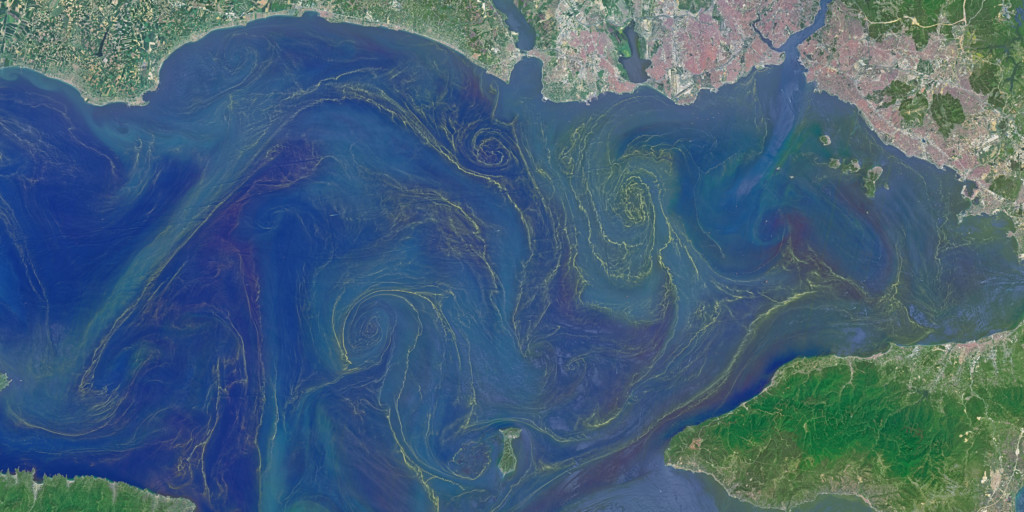
GlobalHAB: SCOR is currently cofunding, with the Intergovernmental Oceanographic Commission (IOC) of UNESCO, an infrastrutural program on harmful algal blooms called GlobalHAB. This program was an outcome of the SCOR/IOC research project called the Global Ecology and Oceanography of Harmful Algal Blooms (GEOHAB) project, which developed from SCOR/IOC WG 97 on Physiological Ecology of Harmful Algal Blooms.
IAPWS/SCOR/IAPSO Joint Committee on Seawater: The Joint Committee on Seawater of the International Association for the Properties of Water and Steam (IAPWS), SCOR, and the International Association for the Physical Sciences of the Ocean (IAPSO) was formed following the completed work of SCOR/IAPSO WG 127 on Thermodynamics and Equation of State of Seawater, which created the Themodynamic Equation of State-2010 (TEOS-10). It was recognized at that time that progress needed to continue on the development of relationships between temperature and salinity of seawater outside the range of previously available equations.
The work of the Committee is mostly conducted at annual IAPWS meetings. The Committee has subdivided its work into three task groups: (1) salinity/density, (2) pH, and (3) moist air. The Committee also has expertise in thermodynamics, numerical modeling and applications, and software. The Committee includes representation from industry.
International Ocean Carbon Coordination Project (IOCCP): SCOR currently supports the International Ocean Carbon Coordination Project (IOCCP) jointly with IOC. IOCCP was formed following the SCOR-IOC CO2 Panel.
Southern Ocean Observing System (SOOS): SCOR is currently supporting the Southern Ocean Observing System (SOOS) with the Scientific Committee on Antarctic Research (SCAR).